

Last week, more that 1500 academics from 57 countries gathered in Vienna to attend and participate in the 25th International Congress of Byzantine Studies.
Before the congress kicked off in Vienna, the host city put on a fantastic lineup of public events to bring the empire’s legacy to life. Centred around the theme “Byzantium Beyond Byzantium,” these events set out to show how much Byzantine culture still shapes our everyday lives, from legal principles and church architecture to how we measure gold and trace local history.
The city-wide programme featured brilliant exhibitions, including rare papyri at the Austrian National Library, Byzantine coins at the Postsparkasse, and historic icons at the Church of the Holy Trinity. Visitors could also catch a live performance by the Baroque Arabesque music ensemble, a display of historical costumes presented alongside Vienna’s Sudanese community, and plenty of city walks and interactive board games.
Speaking to Rudolphina Magazine, Prof. Claudia Rapp highlighted how modern research, whether it’s deciphering everyday prayers for silkworms or reading ice-core pollen counts, is constantly breathing new life into our understanding of Byzantine society. All in all, the congress and its public events proved once again why Vienna remains such a vibrant, world-leading hub for Byzantine research, making this fascinating civilization genuinely accessible to everyone.
A massive thank you to all the friends, readers, and followers who stopped us in the corridors, caught up with us over coffee, or popped by to say hello! Meeting so many of you in person was one of the highlights of our week in Vienna. Your kind words, great conversations, and shared enthusiasm are what make the Βυζάντιο Explained community so special and we can’t wait to see you all again at the next one!
To capture the breadth of this year’s congress, we reached out to four colleagues from across the field to contribute their reflections to this issue.
Below, they share their impressions on the major research trends, the energy among early-career scholars, and what made Vienna 2026 so memorable.
ICBS 2026: The Highlights & The Memories
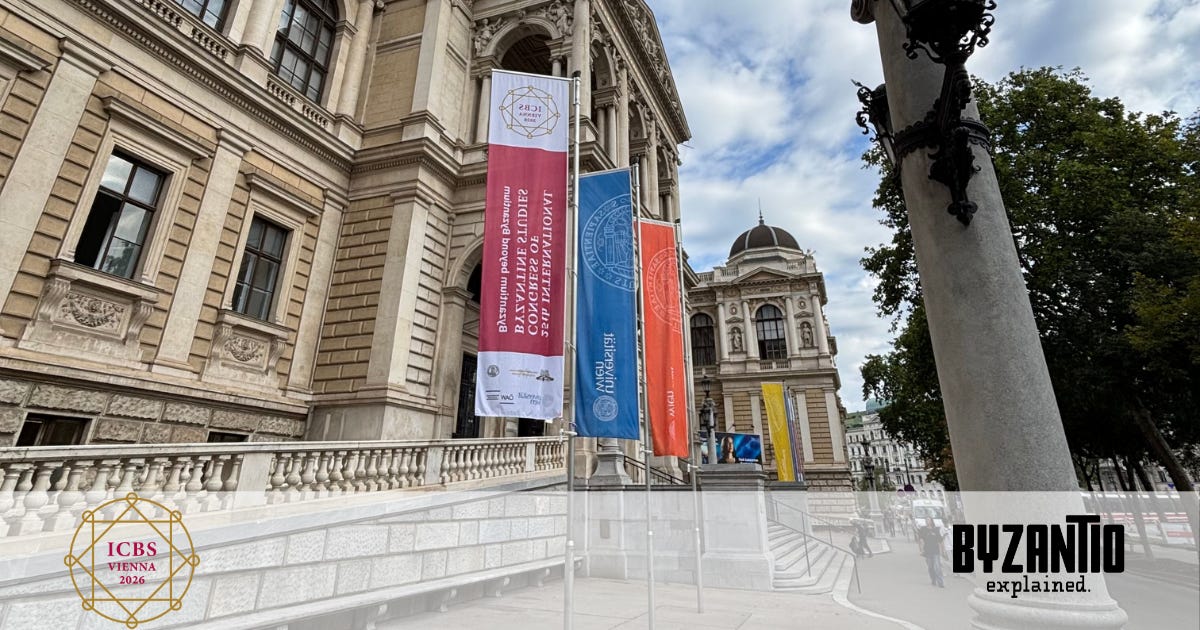
Le 25e Congrès international d’études byzantines, organisé à l’Université de Vienne, s’est achevé après six jours de rencontres, réunissant 1 500 chercheurs venus de 57 pays. Des spécialistes de différentes disciplines ont présenté leurs recherches et échangé leurs points de vue. Les discussions ont porté sur l’histoire, la culture et l’héritage de Byzance, mettant en lumière de nombreux aspects de cette civilisation.
La forte participation, notamment celle de jeunes chercheurs, témoigne de l’intérêt que l’Empire byzantin continue de susciter à travers le monde. Nous quittons Vienne avec de beaux souvenirs et de nombreuses rencontres enrichissantes.
Rendez-vous maintenant en 2031, à Athènes, pour la prochaine édition du congrès.
Anna Kantika, PhD
University of Peloponnese
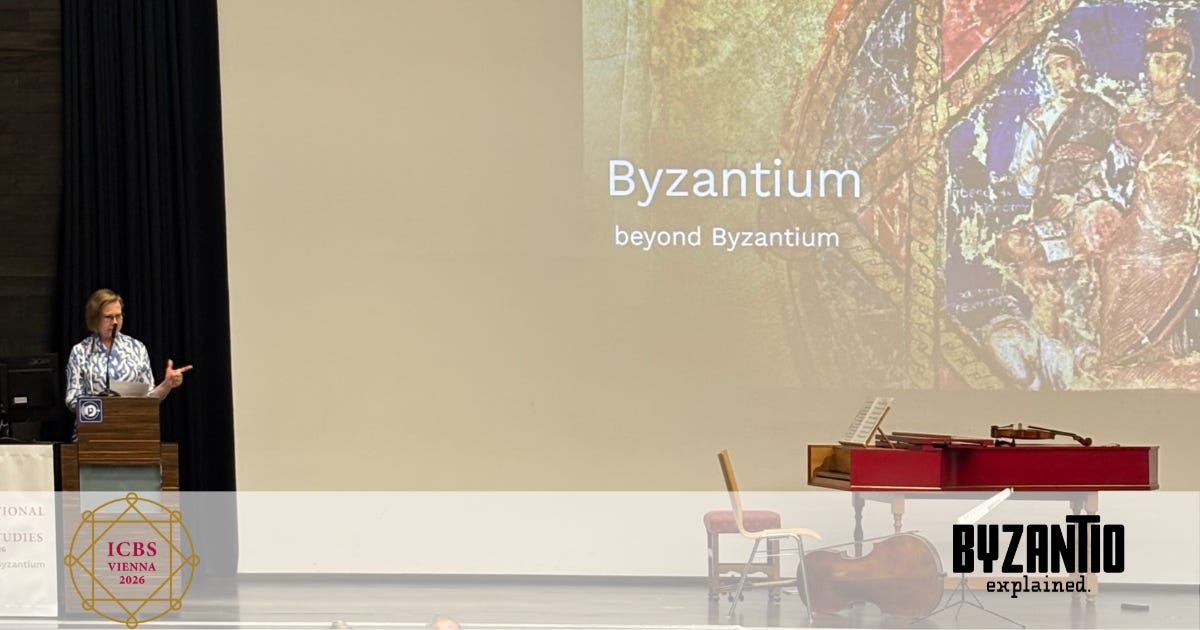
The International Congress of Byzantine Studies comes around only once every five or so years and is our chance to gather, discuss, and share our ideas and research amongst the greatest minds in the field. Countless institutions and projects are represented and the result provides the intrepid Byzantinist with a window into research initiatives across a truly global Byzantine field stretching from the empires’ obvious heirs to researchers worldwide. Diverse fields from epigraphy, palaeography, sigillography, and numismatics meet experts from Scandinavistics, a Eurasian world of Sinology, and Arabacists.
This was my first congress and as a platform for research I could have asked for no more. Our panel, Epiros: The Other Western Rome had the full advantage of excellent facilities, seamless flow from one session to the next, and an expert audience to interrogate our speakers and their sources. Full thanks to Dr. Ekaterini Mitsiou for her help exhibiting our work on the ‘Prosopography of a Fragmented Byzantium: 1204-1261.’
Nathan Websdale
Postdoctoral Research Associate
AHRC-DFG Research Project (2026-2029)
Patronage and Power in the Pre-Modern Mediterranean: Monumental Donor Epigraphy on Mt Athos (10th-17th Centuries)
Faculty of History (Byzantine Studies),
University of Oxford
The ICBS 2026 was particularly special because it brought together so many people I had previously known only online (such as the wonderful Βυζάντιο explained team!) For the past three years, I’ve had the privilege of serving as the ECR/Postgraduate Representative for the Australasian Association for Byzantine Studies, where I’ve also helped establish and run social media accounts, including our Instagram. Through these roles, I’ve become part of a wonderful Byzantine studies community, but many of those connections had existed entirely online.
Coming all the way from Australia to Vienna made finally meeting these colleagues in person especially meaningful. I loved presenting my research to such a receptive audience, hearing so many engaging papers and learning from scholars from around the world. It was special to see a community that had existed largely through screens become real friendships and conversations on the other side of the world. I feel very fortunate to have been part of it.
Olympia Nelson
PhD Candidate in Modern Greek & Byzantine Studies
University of Sydney
Attending the International Congress of Byzantine Studies in Vienna was a particularly rewarding experience, both academically and personally. I had the opportunity to present part of my doctoral research on Demetrios Kydones’ Greek translation of Thomas Aquinas’ Summa Theologiae, focusing on the ways in which translation became a process of selective and creative reception of Latin scholastic thought in Byzantium. Beyond presenting my own work, the Congress offered a unique opportunity to exchange ideas with scholars working across different fields of Byzantine studies and to receive valuable feedback that opened up new perspectives for my research. What I found especially inspiring was the remarkable diversity of approaches represented in Vienna and, at the same time, the sense of belonging to a genuinely international scholarly community. For an early-career researcher, such encounters are a reminder that Byzantine studies remain a vibrant and constantly evolving field, shaped as much by dialogue and collaboration as by individual research.
Angelos Zaloumis,
PhD Candidate in Byzantine Philology and Philosophy
University of Patras & École Pratique des Hautes Études – PSL
They say a picture is worth a thousand words, so we’ll let the photos take it from here! Enjoy a few of our favourite moments, friendly faces, and sights from our week in Vienna.


The Plenary Papers of the ICBS are now published as an edited volume. You can download them open access: Byzantium Beyond Byzantium: Proceedings of the Plenary Sessions at the 25th International Congress of Byzantine Studies (Vienna, 24–29 August 2026), ed. Adrian C. Pirtea, Giulia Rossetto, and Nikos Zagklas (Moving Byzantium 5), Wien: Vienna University Press, 2026.
Check out our Merch!
Every single purchase directly funds our research, production, and audio quality, ensuring we can keep exploring Byzantium together.

We have curated exclusive designs pulled directly from authentic medieval manuscripts. Whether you want to slap a high-quality sticker of a 1204 Crusader Siege onto your laptop, sip your morning coffee from a vibrant Neon Manuscript Procession mug, or sketch your own ideas in an Everyday Byzantine Life notebook, we’ve got you covered.